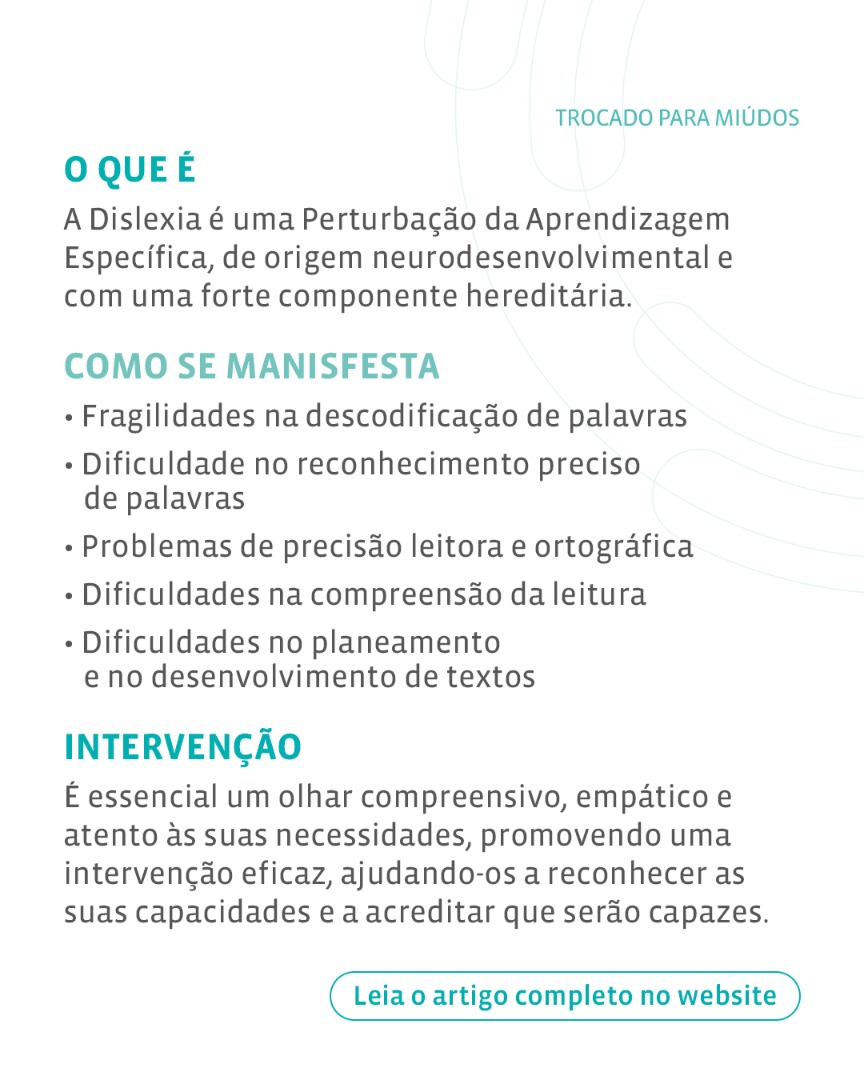





Dyslexia is a Specific Learning Disorder of neurodevelopmental origin with a strong hereditary component. Children with Dyslexia experience significant difficulties in reading and writing, with weaknesses in decoding and accurate word recognition, reading and spelling accuracy (e.g. insertion, omission, substitution and reversal of letters), reading fluency and comprehension, as well as in planning and developing written texts. These difficulties result from deficits in neurocognitive functions such as phonological awareness, rapid naming and working memory, despite normal intellectual functioning.
Dyslexia does not imply an impairment of intelligence. However, due to ongoing academic difficulties, many of these children and young people tend to believe that they are neither intelligent nor capable, often feeling demotivated, insecure and with low self-esteem. Individuals with Dyslexia make a tremendous effort to read and write and, even when they genuinely wish to overcome their difficulties, they are not always able to do so.
For this reason, it is essential to adopt an understanding, empathetic and attentive approach to their needs, promoting effective intervention and helping them to recognise their abilities and believe that they are capable.
The way a person with Dyslexia thinks can differ greatly, not only in comparison with typical readers, but also between individuals with Dyslexia themselves. Some experience greater difficulty reading words and texts, while others are able to read with relative fluency but struggle to understand what they have read, because all their effort has been directed towards decoding. For others, writing a text without mistakes and organising ideas can feel like an “impossible mission”.
I would like to share a few testimonies:
One day, Vitória said to me: “I can’t read, Joana… the letters won’t stay still, they dance.” Vicente complained: “My brain can’t hold on to the letters or the words…”. Isaac only began to memorise the names of the letters when he associated them with football players, finally finding meaning in that learning process. And Diogo wrote to me: “Cadeueto efico muito trste puc nau á dose.”, which, correctly written, would be: “Quando eu entro, fico muito triste porque não há doces.” (“When I come in, I feel very sad because there are no sweets.”)
These testimonies clearly illustrate how reading and writing can be profoundly challenging experiences for those living with Dyslexia. Sometimes, I use the metaphor of a car journey: while most people reach their destination via the motorway, quickly and automatically, individuals with Dyslexia travel along the country roads. They can still reach the same destination, but it may take longer, they may tire more easily and require breaks along the way.
For this reason, it is fundamental to implement appropriate educational strategies, such as adapting materials, providing individualised support, using multisensory methods, not penalising mistakes, reading instructions aloud and allowing extra time for completing tasks and assessments.
However, it is important to highlight that individuals with Dyslexia possess many strengths, even if they do not always show them. They are intuitive, creative and often demonstrate strong problem-solving skills, keen observation and abstract thinking. They develop resilience, perseverance and adaptability in the face of difficulties — powerful tools in the world of work. Dyslexia does not necessarily prevent academic, professional or personal success, but it does require support, understanding and appropriate intervention.
Joana Sarmento Moreira, Psychologist
1, June 2026